
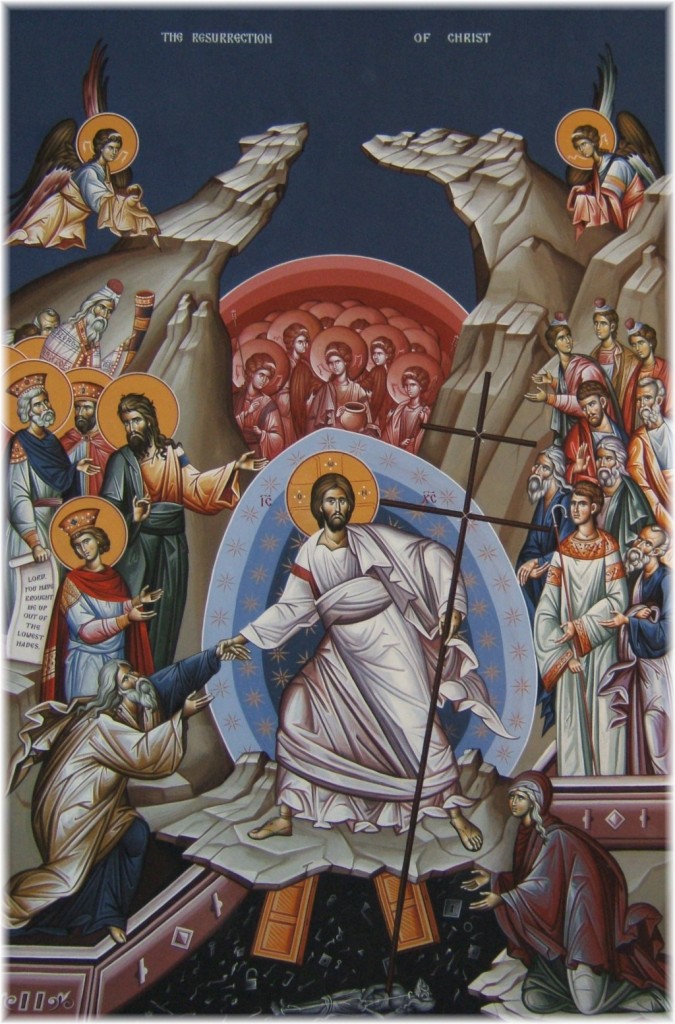
 Christians, we know that “Christ is risen from the dead” (1 Corinthians 15:20) and understand earthly death both as an encounter with the Risen Christ and the door to what the Lord Jesus calls “eternal life” (John 3:16). In this sense, for believers, death is not the end but a new beginning. Christians, as St. Paul writes, “do not grieve as others do who have no hope” (1 Thessalonians 4:13).
When a loved one dies please contact the office at (626)449–6943 or if it is after business hours please call the emergency number at (626)855-3640
In preparation for the funeral:
Choose the mortuary you will be using and contact them. (The office can recommend one to you.) Our tradition as Orthodox Christians is to bury the dead. The body of the deceased is respectfully placed in a casket and set in a grave. The body of the deceased, which St. Paul describes as “a temple of the Holy Spirit” (1 Corinthians 6:19), is returned to the earth from which it was taken (Genesis 2:7).
In conjunction with the Church and mortuary set the day and times for:
The Trisagion the night before the funeral service is usually held at 7 or 7:30PM; the Trisagion is a brief service, no more than ten minutes in length. During this service – as at the Funeral Service the next day – we pray that the Lord will grant forgiveness of sins and rest to soul of the deceased “in the bosom of Abraham (Luke 16:22-23) with Christ and the saints where “there is no pain no sorrow and no suffering” (Revelation 21:4).
** Please note: Funeral services are permitted on any day of the year, except for Sundays and Holy Friday.
The Orthodox Funeral Service is held at the Church (usually 10 or 11 AM) and is normally about an hour long. The Funeral Service consists primarily of the singing of verses from Psalm 119, a series of hymns on the meaning of life and death composed by St. John of Damascus (676-749AD), Scripture readings from St. Paul’s First Letter to the Thessalonians 4:13-18 and the Gospel of John 5:24-30 and a brief homily/eulogy by the priest. The service acknowledges the painful realities of human existence and the frailty of life, yet reminds those present of God’s infinite mercy and love. It asks that we “ponder how brief our life is” but also speaks of the power of the Risen Christ, the Kingdom of God, the resurrection of the dead and immortality. At the conclusion of the service, everyone present is invited to come forward to kiss an icon of the Resurrection and offer their final respects to the deceased. After the congregation and family have offered what the Funeral Service calls “the final kiss” to their loved one, the priest anoints the body of the deceased in the form of a cross with oil and earth reciting several verses from the Scriptures. During the anointing with oil, the priest says: “Wash me with hyssop and I shall be pure; cleanse me and I shall be whiter than snow” (Psalm 51:7); and then, with the placing of earth, he says: “The earth is the Lord’s and the fullness thereof. The world and all who dwell on it belong to Him” (Psalm 24:1) and “You are dust and unto dust you shall return” (Genesis 3:19). **Only the priest offers the homily/eulogy during services in Church. Family members and friends who wish to speak and share memories may do so at the Makaria/ Reception.) Following the Funeral Service held at the Church the deceased is taken to the cemetery where another Trisagion is prayed at the graveside. The deceased is then lowered into his/her grave to await the Second Coming of Christ and, as we confess in the Creed at every celebration of the Liturgy, “the resurrection of the dead and the life of the age to come.”
The Makaria or Meal of Blessing
Following the graveside service, it is customary to invite everyone to a meal called, in Greek, the Makaria. Traditionally in the Greek Orthodox Church, the main dish at the Makaria is broiled fish. This is because the first meal that the Lord Jesus ate with His disciples following His resurrection from the dead consisted of broiled fish and bread, as recorded in the Gospel of John 21:12-13. This meal is a reminder of Christ’s resurrection and His closeness to those who believe in Him.